
I will freely admit this much: I should have known better than to take cover from a desert rain in an arroyo.
My son Rhys and I were on day two of a three-day backpacking trip through the Needles District in Canyonlands, and we were already wet. A forecast thunderstorm had moved in a day early; we had barely finished setting up our tent and were beginning to get set up for dinner when the sky opened up, dumping first tiny hail and then fat raindrops. I briefly considered ducking into the tent, but quickly decided against it—we were both wet and dirty by that point, and I didn’t feel like sleeping in a pile of damp desert sand. Looking down to the arroyo about two dozen feet from our camp, I spotted a jumble of large boulders leaning against the sheer wall of the Canyon and motioned for Rhys to follow me down.
We both crammed ourselves under the narrow, peaked rock roof. It wasn’t a perfect shelter: My legs, which stuck out, were still getting rained on. But it was better than nothing. I managed to shield the stove from the wind well enough, and soon our meals were rehydrating, wrapped in my sweatshirt. I was checking Rhys’s mac and cheese for doneness when he pointed behind me and said “Daddy, look! There’s water in the arroyo!”
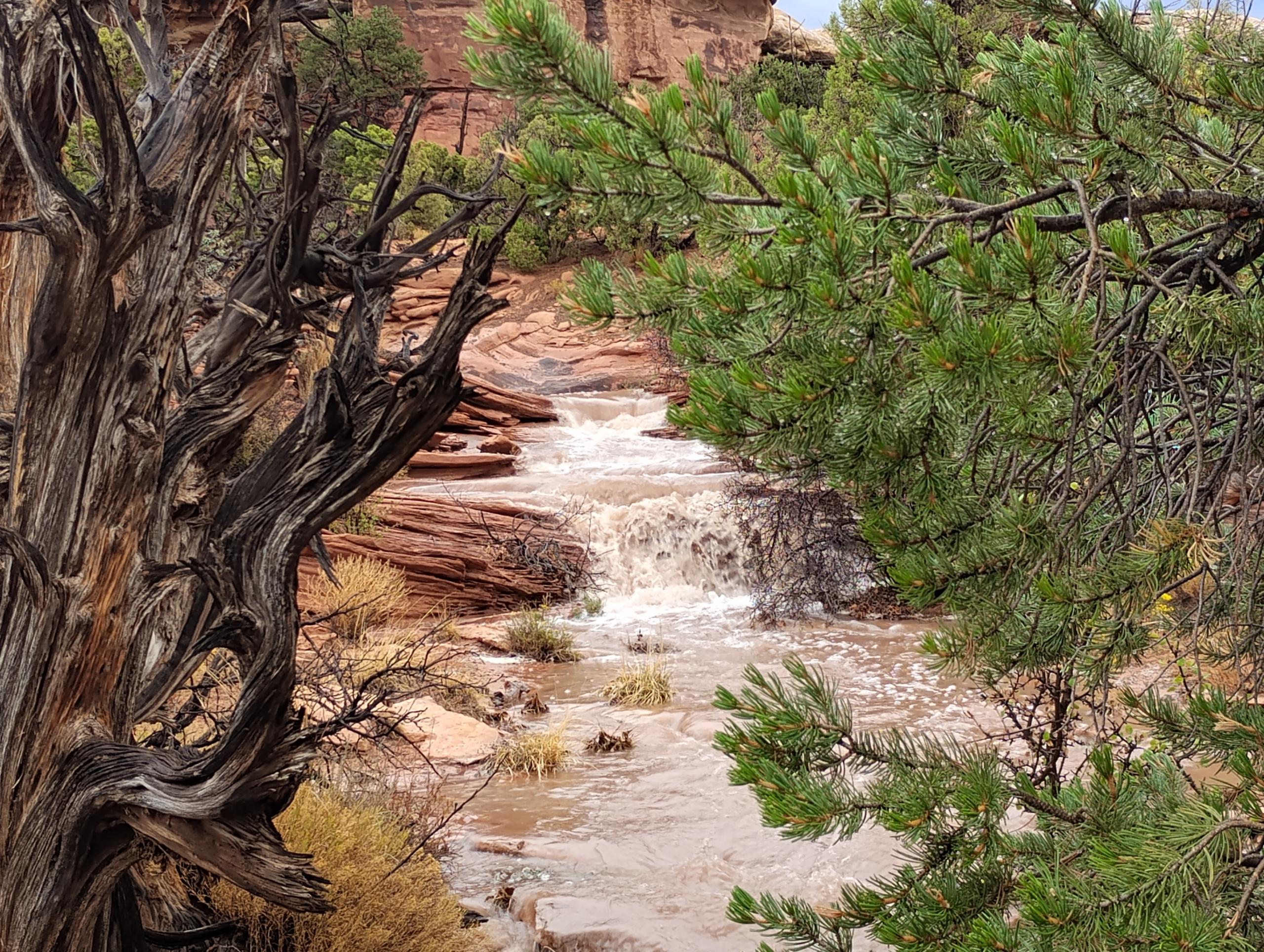
I turned. A trickle of water, creamy brown with suspended dust, was snaking its way down the middle of the arroyo where we sat. I grabbed the stove and rat sack, told Rhys to get up and follow me, and started scrambling my way up the embankment to our campsite.
Within a minute, the trickle had swollen into a shin-high creek covering the breadth of the channel. The sound of rushing water drowned out the percussion of raindrops slapping our Zpacks Duo trekking pole tent. Jumbles of boulders and drops in the arroyo became miniature rapids, churning the water into a milky-white froth.
The hundred-yard stroll from our campsite to the main trail revealed that a brand-new waterfall gushed just below our camp. The broad arroyo that we had crossed to get to our stopping point was now a wide, relatively placid stream. In just a few minutes, a hard rain had completely changed the landscape, turning dry October desert into a braided network of streams.
In a very real way, the desert is built around these kinds of floods. With no permanent streams in the area, animals and hikers alike depend on this kind of inundation to refill seasonal ponds and tanks. Thick cottonwood stands line the low points of canyons in Utah, proof positive of the transient rivers that occasionally take over those dry washes.
I don’t believe we were ever in any danger. Big Spring, the canyon where we camped, was wide, and getting to higher ground was easy. Once the rain petered out and the water receded, I checked the arroyo and found that the sudden flood had stopped just below the nook where we were sitting. If we had stayed where we were, I would have ended up with soaked pant legs and shoes, and we might have spent the next hour or so searching for our cookpot, but that’s about it.
Watching the desert flood from close up was an eye-opening experience, though. As an editor at Backpacker and Outside, I’ve written or edited stories about more canyon-country drownings and flood rescues than I care to count. Seeing the water rise ourselves was a valuable—and visceral—lesson, no matter how it turned out.