
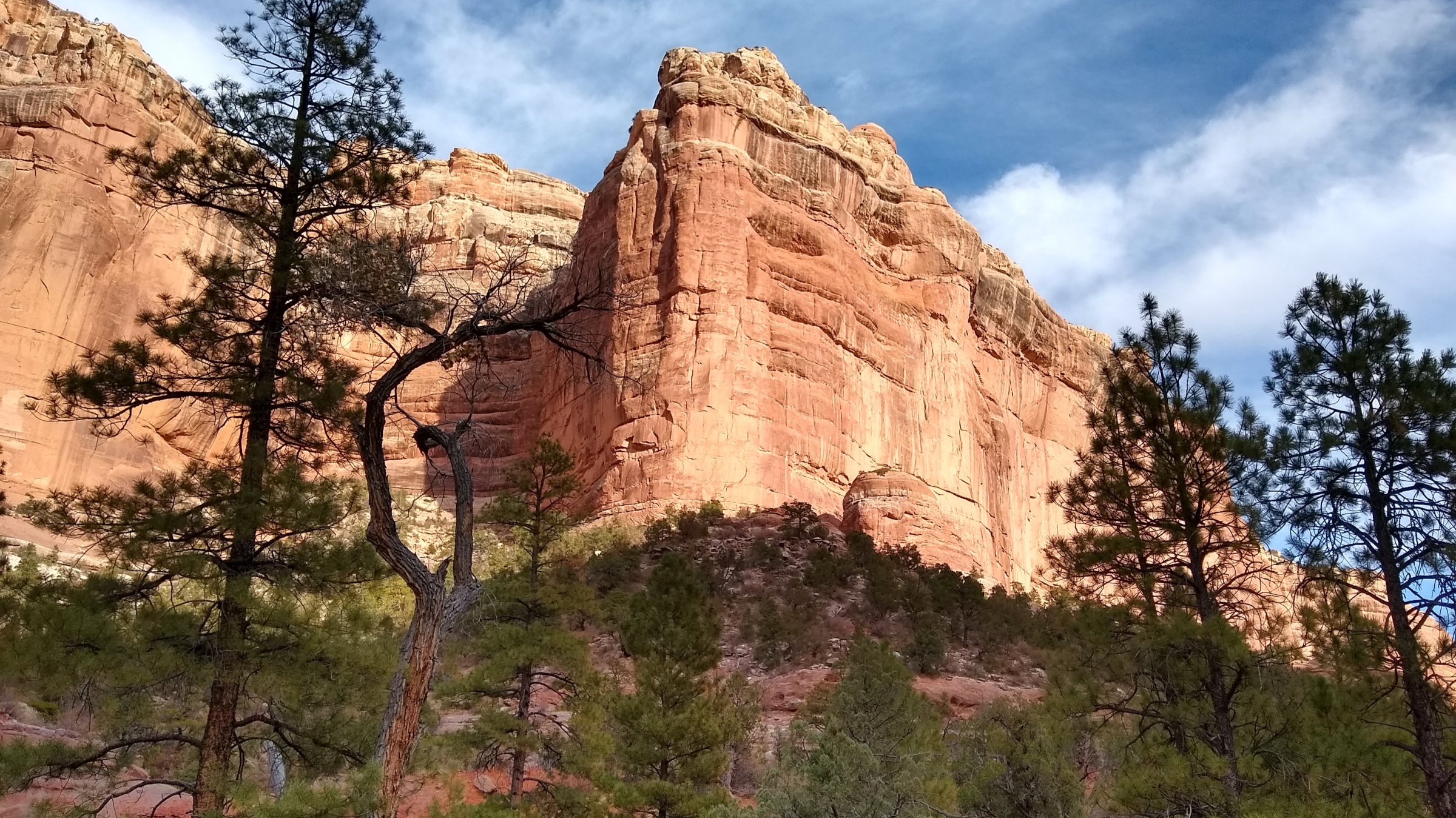
Last week, I recorded an explainer for Backpacker on the Trump administration’s current push to shrink Bears Ears National Monument. In that video, I touched on a question that I think gets at the heart of the conflict over Bears Ears: Who counts as a “local” in discussions over public lands, and who gets ignored? After covering Bears Ears and southern Utah on and off for about 15 years, this is my best attempt to wade through that.
On June 10, 2009, nearly 100 federal agents in tactical gear fanned out across Blanding, a small city of about 3,300 people located in San Juan County in far southeastern Utah. Their targets were a loose network of local pot hunters and dealers in Native artifacts, who an undercover informant had identified over the course of a two-and-a-half-year operation. In a series of early-morning raids there and across the Four Corners region, agents arrested 23 people and confiscated a total of 40,000 artifacts ranging from shell fragments to slippers, unlawfully collected from public land.
While almost all of the defendants got off with fines and probation—only one, Charles Denton Armstrong, would ultimately do prison time after threatening to beat the government’s informant with a baseball bat—the personal fallout was immense for some. Within weeks of the raid, two of the people arrested took their own lives, including Dr. James Redd, a respected local physician; Ted Gardiner, the government’s informant, would kill himself as well the following year. Contemporary newspaper articles and letters to the editor describe a town furious with what it saw as federal overreach: “What is so criminal about the behavior of these tax-paying citizens raided and humiliated by the regime’s Gestapo?” one person wrote to the local San Juan County Record. Utah’s then-senators, Bob Bennett and Orrin Hatch, called for a congressional investigation.
Another story: In December 2017, President Donald Trump signed an executive order shrinking Bears Ears, a national monument covering 1.3 million acres of federal land in San Juan County, by 85 percent. The administration argued that when Obama had designated the monument a year prior, he had done so over the vehement objections of locals, who would have preferred the land remain available for multiple uses like mining and drilling. A BLM press release announcing the decision certainly seemed to support that: Alongside Hatch and Utah Governor Gary Herbert, the release quoted Rebecca Benally, the lone Democrat and Navajo member of the San Juan County Commission, who praised Trump’s courage and said he was “rectifying a wrong” by shrinking the monument.
“We may be only 15,000 strong, but we matter,” Benally said of the county. “We appreciate you willing to take the backlash from the special interest groups as you stand for the people and the economy of San Juan County.”
Formalizing the changes turned out to be a slow process, and it wasn’t until February of 2020 that the BLM announced that it was ready to share its final management plan for Bears Ears. An eagle-eyed reader, however, might have noticed that there was a curious omission in the new press release. While it again quoted a lineup of Utah congressmen and senators, neither Benally nor any other member of the San Juan County Commission got a mention. In the chorus of praise for the Trump administration’s cuts to Bears Ears, the locals had fallen silent.
Why does it matter who the government quoted in two announcements released years apart? And what does it have to do with an FBI raid that happened almost a decade prior? Taken together, these two stories can teach us a lot about who actually counts as a “local” when it comes to public land, and how that term—key in the fight over Utah’s national monuments—has been used and abused. To understand why, you have to be willing to read between the lines.
The reason why the San Juan County Commission didn’t appear in that second release was simple: It no longer supported the administration’s plan to shrink Bears Ears. In 2018, the county had flipped, electing the first majority-Navajo commission in Utah history.
Six years earlier, in 2012, the Navajo Nation had sued San Juan County in federal court, alleging that it had racially gerrymandered its electoral maps in violation of the 14th Amendment and the Voting Rights Act. While more than 50 percent of San Juan County’s residents are Native the maps packed most of them into a single district, leaving the county’s white minority to elect two of the three seats on the commission. District Court Judge Robert Shelby ruled in the Navajo Nation’s favor and ordered San Juan County to redraw its maps; when the county submitted its revised map, Shelby rejected it as still racially gerrymandered and appointed a special master to redraw the districts.
In the ensuing election cycle, Benally lost a close Democratic primary to Kenneth Maryboy, a former commissioner and board member of Utah Diné Bikéyah, a Navajo organization dedicated to protecting Bears Ears. Another board member, Willie Grayeyes, had to sue to get on the ballot after the county disputed his residency. Maryboy and Grayeyes would go on to capture two of the three districts in the general election. In its first meeting in February 2019, the new commission voted to rescind its prior opposition to Bears Ears, condemned the Trump administration’s reduction of it, and called on the president to restore it to its previous size.
The White House’s reply: silence. Before the election, Trump and former Interior Secretary Zinke had met with Benally and Bruce Adams, the commission’s lone remaining white member. Now, the administration and its supporters in Utah froze out Maryboy and Grayeyes, who collectively represented two-thirds of San Juan County. When the county had supported the White House’s plans, it had been an asset; now, it was a liability, and the federal government opted to simply ignore it. A year after the commission called for the restoration of Bears Ears, Bishop preached that the administration was “tak[ing] actions that reflect the will of Utahns who call these places home,” in a press release that no longer featured a single member of the county’s government.
In the debate over how America should manage its public lands, the archetypal Local is a powerful symbol. Where visitors see new, exciting landscapes, the argument goes, locals see the full weight of their history; where visitors enjoy the benefits of land protections, locals live hobbled by their restrictions. But as this story makes clear, the image of the Local that the Trump administration has invoked to support its plans for Bears Ears is a curated one that places some residents’ perspectives over other, disproportionately Indigenous, voices.
While not a monolith by any stretch, the majority of Navajo voters in San Juan County and beyond have backed Bears Ears. Data compiled by Utah Diné Bikéyah show that in local meetings of the Navajo Nation chapters that straddle the Utah-Arizona state line, 98 percent of members voted in support of the monument. Along with the Hopi, Zuni, Ute Mountain Ute, and Ute Tribe of the Uintah and Ouray Reservation, the Navajo were one of the five tribes that petitioned the federal government to designate Bears Ears a national monument, and sued when it was first reduced.
The tribes hoped that a monument designation would provide the resources necessary to protect Bears Ears’ thousands of cultural sites from the vandalism and theft that had become endemic. Since 1979, it has been a crime under the Archaeological Resources Protection Act to remove or traffic any human-made item over 100 years old from federal or tribal land. The penalties can be stiff, with a felony conviction punishable by years in prison or hundreds of thousands of dollars in fines. But with each of the BLM’s law enforcement rangers responsible for patrolling more than a million acres, enforcement is practically impossible. That’s probably why the FBI’s 2009 raid came as such a shock to white residents of Blanding, who had been hunting pot sherds and arrowheads unmolested for decades—and why, to some members of the county’s Native majority, it seemed overdue.
While many media reports after the raids painted a picture of a town united in its anger at the federal government’s heavy-handed approach, contemporary interviews with Native residents and experts complicate that narrative. Speaking to the Navajo Times shortly after the raids, Kerry Thompson, a Navajo archeologist and professor at Northern Arizona University, called the arrests “entirely appropriate.”
“These kinds of crimes go unpunished so much in the Southwest,” she told the paper. “People tend to think they have free rein over archeological sites on federal and tribal land. This looting and pot hunting is disrespectful and completely racist.”
Kenneth Maryboy, then in his first stint as a San Juan County commissioner, had a personal connection to the case: He was a patient and friend of James Redd, and attended the doctor’s funeral. Nevertheless, he told NPR after Redd’s wife and daughter pled guilty that there was “outrage” over the revelation that the family had disturbed Native graves.
“To find out that this has been going on for quite some time, that’s kind of disturbing,” Maryboy said. “They are good people. And it’s kind of hard to imagine that they would do such things.”
It’s fair to question, as many did following the Blanding raids, whether it was necessary to send a full company of flak-jacketed agents to arrest suspects accused of nonviolent crimes. And while opposition to Bears Ears in San Juan County isn’t as united as the White House portrays, it’s still real: In 2022, both Maryboy and Grayeyes lost their seats, leaving the county commission under unanimous Republican control.
As someone who spent the front half of his twenties living in western tourist towns, I also understand the frustration of feeling like your home is being managed for someone else’s benefit. But as the White House once again slashes Bears Ears, it’s also worth asking exactly which residents’ interests they’re acting in, and why. Deciding whose voice counts is a fraught exercise anywhere. In southeastern Utah, that’s a decades-old question that could change the fate of an ancient landscape.